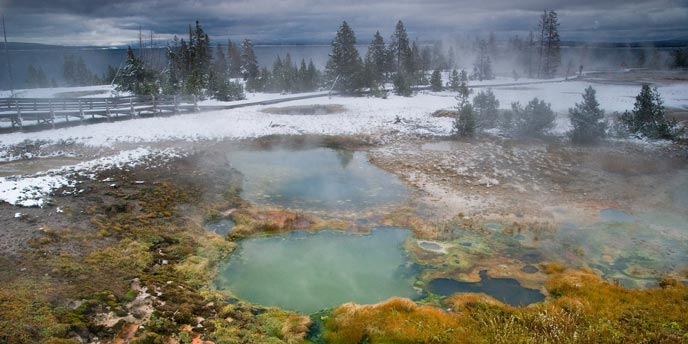
West Thumb Geyser Basin: Yellowstone's First Documented Wonder
Nestled along the pristine shores of Yellowstone Lake, the West Thumb Geyser Basin in Yellowstone National Park stands as a mesmerizing testament to Earth's raw, untamed power. With steam rising gracefully from crystal-clear, vibrantly colored pools and geysers that bubble and erupt against the serene backdrop of America's largest alpine lake, it offers a truly distinctive geothermal encounter. More than just a breathtaking spectacle, West Thumb holds a unique and historically significant place in the narrative of Yellowstone National Park, recognized as the very first feature of this majestic landscape to be described in a published account.
This ancient volcanic crater, approximately 150,000 years old, invites visitors to wander its boardwalks, witnessing the extraordinary fusion of natural beauty and powerful geothermal activity. The vibrant hues of its features—from deep blues and greens to fiery oranges and reds—showcase the geothermal wonders of Yellowstone in a breathtaking display. Yet, to fully appreciate the West Thumb Geyser Basin, one must delve into its past, back to a time when its wonders were first timidly recorded by intrepid explorers, paving the way for the world's eventual fascination with Yellowstone.
The Dawn of Documentation: Daniel T. Potts and the 1827 Letter
Long before Yellowstone became a national park, its hidden thermal marvels were a source of awe and mystery to the few mountain men and trappers who ventured into its remote wilderness. Among these early pioneers was Daniel T. Potts, a trapper operating in the Yellowstone region during the 1820s. Potts's observations of the area around what is now known as the West Thumb Geyser Basin were so striking that he penned a letter to his brother in Philadelphia, Pennsylvania, detailing his extraordinary experiences. This letter, after being corrected for punctuation and spelling, made history when it was published in the Philadelphia Gazette on September 27, 1827. It marked the first ever published description of any Yellowstone feature, forever cementing West Thumb's place as Yellowstone's documented "first wonder."
Potts's vivid, though perhaps raw, account provides a captivating glimpse into the northern part of the West Thumb Geyser Basin, an area now affectionately known as "Potts Basin." He described:
"...on the south borders of this lake is a number of hot and boiling springs some of water and others of most beautiful fine clay and resembles that of a mush pot and throws its particles to the immense height of from twenty to thirty feet in height. The clay is white and of a pink and water appears fathomless as it appears to be entirely hollow under neath. There is also a number of places where the pure sulfur is sent forth in abundance. One of our men visited one of those whilst taking his recreation. There at an instant the earth began a tremendous trembling and he with difficulty made his escape when an explosion took place resembling that of thunder. During our stay in that quarter I heard it every day."
This remarkable passage not only offers a dramatic depiction of mud pots and the intense geothermal activity – including what sounds like a substantial geyser eruption or steam explosion – but also underscores the sheer power and unpredictable nature of Yellowstone that captivated these early observers. It speaks to a landscape so alien and powerful that it demanded a written record, despite the rugged conditions and limited means of communication.
Early Scientific Exploration: The Folsom-Cook-Peterson Expedition
Decades after Potts's initial account, Yellowstone's wonders began to attract more systematic attention. In 1869, the Folsom-Cook-Peterson Expedition became the first organized scientific exploration to venture into the Yellowstone area. Their visit to the West Thumb Geyser Basin further expanded the documented knowledge of this unique locale. David Folsom, a member of the expedition, penned a more detailed and scientific description of the area, painting a picture that resonates with what visitors still experience today.
Folsom described springs "differing from any we had previously seen," noting their distribution along the shore for two miles, extending back about five hundred yards and even "into the lake perhaps as many feet." He estimated "several hundred springs here, varying in size from miniature fountains to pools or wells seventy-five feet in diameter and of great depth." His observations of the water's appearance, with a "pale violet tinge" and remarkable clarity allowing them to "discern small objects fifty or sixty feet below the surface," highlight the exquisite beauty and depth of features like the renowned Abyss Pool. Furthermore, Folsom echoed Potts's fascination with the mud pots, noting "a small cluster of mud springs near by claimed our attention. These were filled with mud, resembling thick paint of the finest quality, differing in color from pure white to the various shades of yellow, pink, red and violet. During the afternoon they threw mud to the height of fifteen feet." These early, meticulous descriptions helped lay the groundwork for understanding Yellowstone's complex geothermal systems.
A Journey Through Time: West Thumb's Evolving Visitor Experience
The significance of the West Thumb Geyser Basin wasn't lost on early park developers either. Historically, it served as a crucial hub for visitors exploring Yellowstone. In the late 19th and early 20th centuries, travelers arriving from the Old Faithful area by dusty, bumpy stagecoach often faced a choice at West Thumb: endure further overland travel or embark on a more comfortable journey aboard the steamship "Zillah." This elegant vessel offered passage across Yellowstone Lake to the majestic Lake Hotel, with its boat dock conveniently located near the south end of the basin, close to features like Lakeside Spring. This multimodal travel option underscored West Thumb's importance as a gateway and a place of transition.
Over the decades, the West Thumb area saw significant development to accommodate growing visitor numbers. What is now a relatively undeveloped and protected thermal basin once hosted a large campground, cabins, a photo shop, a cafeteria, and even a gas station. This infrastructure was situated immediately adjacent to the geyser basin itself. While convenient for visitors at the time, this close proximity to fragile thermal features highlighted a shift in conservation philosophy over the years. Today, much of this past development has been removed or relocated, reflecting the park's commitment to preserving the delicate ecosystem and ensuring a more natural, unimpeded visitor experience of the geothermal wonders. This evolution in infrastructure management helps protect the very features that draw millions to Yellowstone, including those unique lakefront geysers and mud pots you can discover at West Thumb today.
West Thumb Today: Mesmerizing Features and Essential Visiting Tips
Today, the West Thumb Geyser Basin continues to captivate. Its distinction as the largest geyser basin on the shores of Yellowstone Lake remains, offering a concentrated display of thermal activity that is easily accessible via well-maintained boardwalks. Visitors can marvel at iconic features such as the famous Fishing Cone, where early anglers reportedly cooked their catch; the vibrant Black Pool, named for its dark waters; and the stunning Abyss Pool, whose remarkable depth and clarity mesmerized early explorers like Folsom. The contrast of the bubbling hot springs and steaming fumaroles against the vast, often snow-capped mountains across Yellowstone Lake creates an unparalleled scenic vista.
For an unforgettable exploration of the West Thumb Geyser Basin in Yellowstone National Park, consider these practical tips:
- Best Time to Visit: Early mornings or late evenings offer fewer crowds and often more dramatic lighting for photography, with steam rising exquisitely in the cooler air. Winter visits provide a truly magical, quiet experience.
- Dress in Layers: Weather can change rapidly, even in summer. Be prepared for sun, rain, and cool lake breezes.
- Stay on Boardwalks: For your safety and the preservation of the delicate thermal features, always remain on designated boardwalks and trails. The ground in geothermal areas can be thin and extremely hot.
- Bring Water and Snacks: While there are limited services nearby, it's always wise to carry your own refreshments.
- Photography: The reflections in the pools and the steam rising over the lake provide incredible photographic opportunities. A polarizing filter can enhance the vibrant colors.
- Combine with Lake Activities: Since West Thumb is right on Yellowstone Lake, consider combining your visit with a boat tour or fishing excursion for a full lake district experience. For more on the lake's geothermal wonders, you might want to experience West Thumb: Yellowstone Lake's Mesmerizing Geothermal Oasis.
The West Thumb Geyser Basin is more than just a collection of hot springs; it's a living museum where natural wonder meets human history. It reminds us of Yellowstone's raw power, the courage of its first observers, and the ongoing efforts to preserve this unique landscape for future generations.
